
By Elle Nicholson, TXSES Researcher
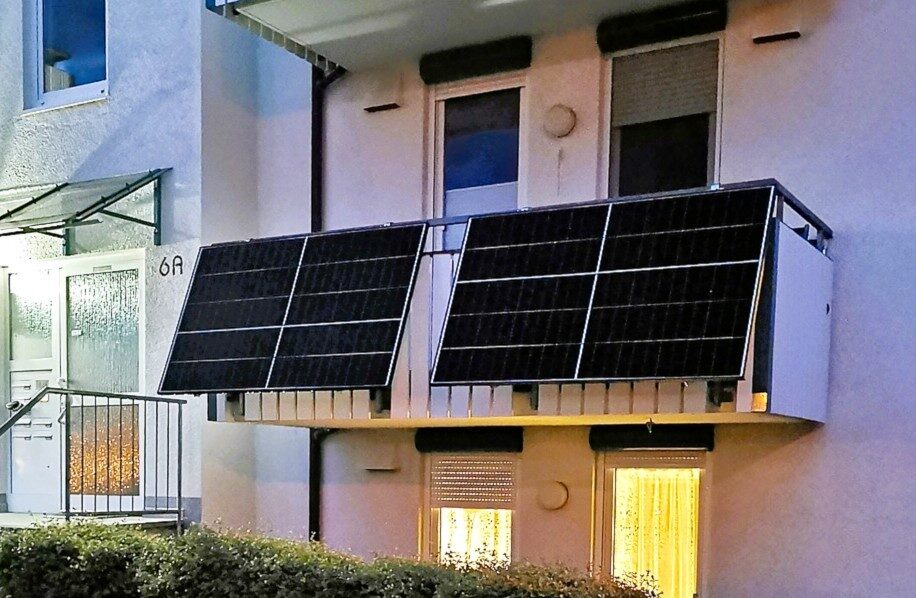
Historically, solar panels have not always been feasible in urban environments due to spacing issues. However, new solar technology has recently emerged that can provide renewable energy even in limited spaces. Balcony solar panels are compact (300–800 watt) systems consisting of a few PV panels, an inverter, and battery storage. The systems can be fixed upon balcony railings, walls, or stands and are designed to be modular. As such, they are most frequently installed on multifamily apartment and condominium buildings.
There are a variety of benefits to installing balcony solar panels. Like traditional rooftop solar panels, they reduce energy bills and reliance on the power grid. For example, one owner interviewed by a German news outlet said he is able to produce enough solar for half of his family’s daily needs. When compared to rooftop solar, balcony solar does not disrupt existing structures or require access to a roof, solving two major issues that come up with traditional solar panels. Additionally, installing balcony solar is substantially cheaper than rooftop solar. Differing models range in price from around $400–$2,000, depending on the size of the system. In contrast, rooftop solar installations can cost tens of thousands of dollars and will become more expensive with the upcoming removal of federal tax credits. Such characteristics make balcony solar panels an appealing option in circumstances where rooftop solar is unrealistic.
Nevertheless, there is a noteworthy downside to balcony solar—the panels’ small size means they produce significantly less energy than traditional panels. Moreover, some balconies may have less exposure to sunlight than a rooftop would have, due to shading from higher apartment units or nearby buildings. This results in more modest utility bill savings, so solar panels may not be worth the investment for some apartment owners.
While balcony solar panels have not taken off yet in the US, they have become widely popular in parts of Europe, particularly Germany. Germany currently has around 550,000 balcony solar systems installed, adding 200 MW of power to their grid in the first half of 2024 alone. This popularity is partially because apartment dwellers comprise more than half the population of Germany, and partially because the technology helps combat increased energy prices following the Russian invasion of Ukraine. Many German cities offer subsidies for balcony solar, as well, making the systems more affordable for consumers.
Conversely, the US has very few balcony solar systems installed. This is largely due to poor regulations that have not kept pace with emerging solar technologies. Electrical interconnection agreement regulations govern how electricity generating resources, such as solar panels, connect to the power grid. In nearly every state, these regulations include balcony solar panels, forcing balcony solar owners to adhere to strict requirements designed for larger solar projects. This makes balcony solar more difficult to install and is an unnecessary measure for a home system of such small wattage. In addition, balcony solar has not been approved to comply with the National Electrical Code or an Underwriters Laboratories standard—key safety certifications that would spark more interest among apartment owners and make them easier to attain.
Improving regulations to appropriately cover balcony solar panels could help the technology gain traction in the US, therefore opening new avenues for renewable energy in urban environments. One California startup, Bright Saver, provides a real-world illustration of this need. The company has begun installing balcony solar systems, marketing them as appliances, rather than construction projects, to bypass strict municipal permitting requirements. To avoid state interconnection requirements, Bright Saver chooses to use complex energy monitors that prevent any surplus electricity from flowing back into the power grid. Unfortunately, such measures are expensive and time-consuming, showing the need for improved regulatory standards in order for balcony solar panels to flourish. By updating regulations to keep pace with technological advancements, the US can follow Germany’s lead and reap the benefits of balcony solar systems.
References:
- https://eu.oukitel.com/blogs/news/balcony-solar-panels-the-pros-cons-and-pay-back
- https://we.do.solar/blogs/international/faq-balcony-solar?srsltid=AfmBOoosenteY1Qb7YltC1JZCu84RAv5akkbfHbK-gkOXpMgE3D7k0eF
- https://grist.org/buildings/how-germany-outfitted-half-a-million-balconies-with-solar-panels/
- https://www.wired.com/story/why-balcony-solar-hasnt-taken-off-in-the-us/
- https://www.pv-magazine.com/2025/04/28/balcony-solar-gains-us-foothold-with-plug-and-play-systems/
- https://www.renewableenergyworld.com/solar/residential/solar-panels-that-fit-on-your-balcony-or-deck-are-gaining-traction-in-the-us/
- https://apnews.com/article/balcony-plug-solar-climate-energy-renewable-trump-c162abf520da0fa155dc971270b8684a
Image: Sogenanntes Balkonkraftwerk, eine Mini-PV-Anlage, in Tauberbischofsheim ©User: Andek/Wikimedia Commons/CC-BY-SA-3.0